
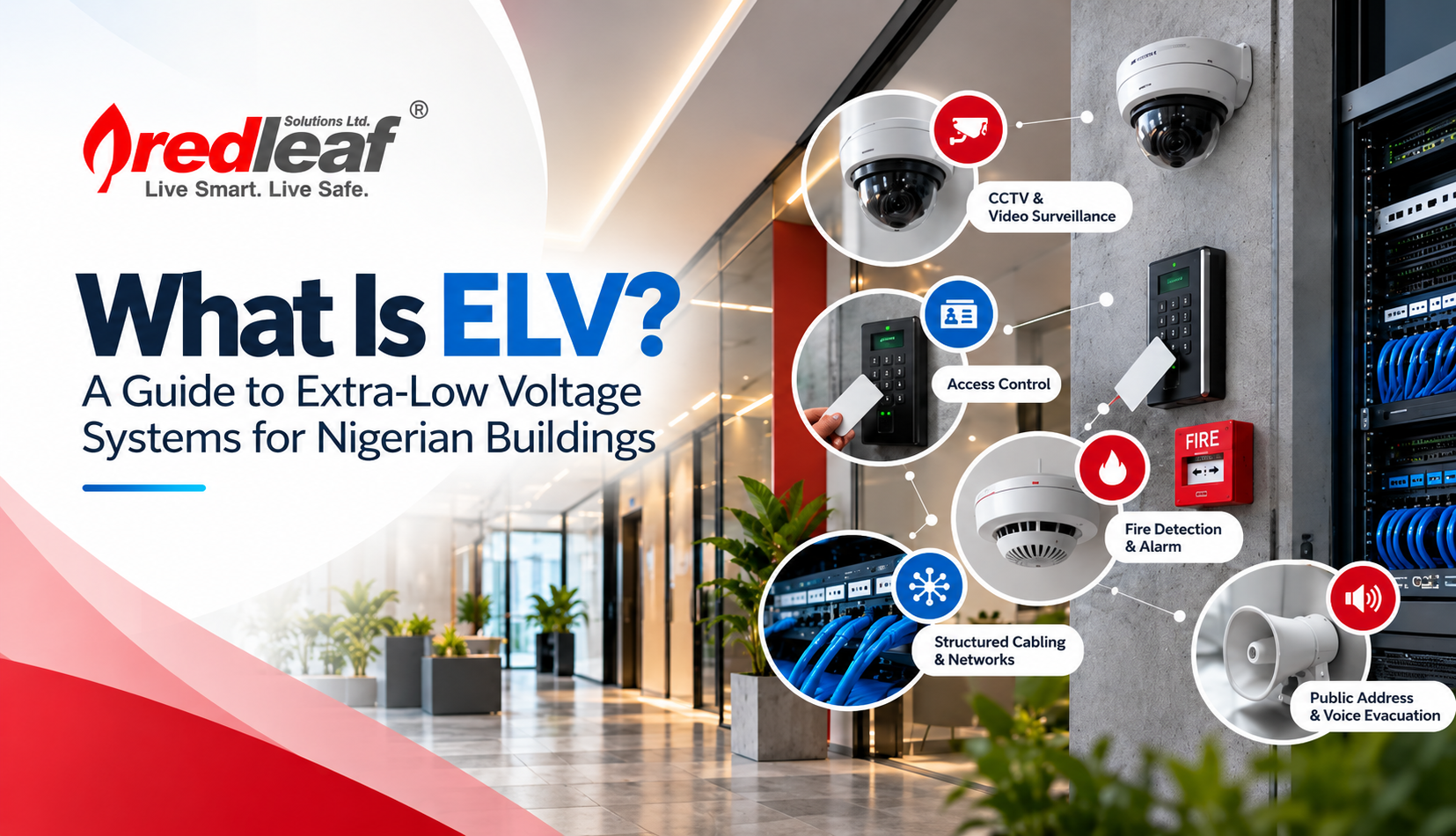
ELV stands for extra-low voltage. It is the name given to the building systems that run on low-power circuits and carry signals, data and control instead of heavy electrical load. CCTV, access control, fire alarms, structured cabling, public address and building automation are all ELV systems.
This guide explains what ELV means, which systems it covers, why Nigerian buildings depend on it, and how to choose an ELV solutions company Lagos businesses can work with. It is written for developers, facility managers, consultants and building owners who are planning a new project or upgrading an existing one.
In electrical standards, extra-low voltage generally refers to circuits operating at 50 volts AC or 120 volts DC or below, which is far lower than the mains supply in a building. Because the voltage is low, these circuits carry a much lower risk of electric shock, and they are used for signals, communication and control rather than for powering heavy equipment.
In the building industry, “ELV” has become shorthand for the whole group of systems built on this kind of wiring. It sits alongside the main electrical installation, which supplies power to lights, sockets, air conditioning and motors, but it is designed, installed and tested as its own discipline.
The difference matters in practice. Electrical contractors install and protect the building’s power supply. ELV specialists design the systems that watch, protect, connect and monitor the building, and they depend on that power supply and on a well-planned network of cabling and pathways.
The exact list varies by project, but most buildings use a combination of the following.
| System | What it does | Typical use |
| CCTV and video surveillance | Records and monitors areas, with analytics and remote viewing | Offices, estates, factories, car parks |
| Access control | Controls who enters which areas, using cards, PINs or biometrics | Offices, data centers, hospitals |
| Intrusion detection and alarms | Detects unauthorised entry and raises alerts | Homes, shops, warehouses |
| Fire detection and alarm | Detects smoke, heat or fire and warns occupants | Every occupied building |
| Structured cabling and networks | Provides the data backbone for voice, internet and other systems | Offices, campuses, data centers |
| Public address and voice evacuation | Broadcasts announcements and emergency instructions | Malls, airports, schools, hotels |
| Intercom and nurse call | Provides communication between rooms, gates and staff | Apartments, hospitals, gated sites |
| Gate, turnstile and parking systems | Manages vehicle and pedestrian entry | Offices, estates, car parks |
| Audio-visual and TV distribution | Supports meeting rooms, displays and signage | Conference centers, hotels |
| Building management and automation | Monitors and controls lighting, cooling and other plant | Large commercial and industrial buildings |
These systems are strongest when they share information. For example, a fire alarm can release access control doors, and an intrusion alarm can direct cameras to the right area. Our ELV and security solutions are designed to work this way.
ELV systems are no longer optional extras. They shape how safe, secure and usable a building is from the day it opens.
Getting ELV right at the start also avoids costly rework later. Cable routes, equipment rooms and power points are far cheaper to plan before walls are closed than to add afterwards.
Nearly every modern building uses some ELV, but the mix depends on the building’s purpose.
Most ELV projects follow the same stages, whether the building is a small office or a large campus.
Involving the ELV team early, ideally at concept or design stage, gives the best results.
The right ELV Systems Integrator in Lagos reduces risk and delivers systems that keep working. Look for these qualities:
Learn more about Redleaf Solutions and how we work as an ELV Service Provider Nigeria businesses can consult for building security and connectivity requirements.
ELV stands for extra-low voltage. It refers to low-power electrical systems used for security, communication, safety and control in buildings.
Electrical works supply mains power to lighting, sockets, air conditioning and equipment. ELV works install the low-power systems for security, data, fire detection, communication and automation.
Common ELV systems include CCTV, access control, intrusion and fire alarms, structured cabling, public address, intercoms, nurse call, parking and gate systems, audio-visual and building automation.
As early as possible, ideally at concept or design stage. Early planning allows cable routes, equipment rooms and power needs to be coordinated with the other trades.
Separate contractors can work, but an integrator takes responsibility for the whole scope and ensures the systems work together, which reduces coordination risk.
ELV systems quietly decide how secure, safe and connected a building is. Planning them early, choosing a capable integrator and maintaining them well are what separate systems that work from systems that merely exist.
Redleaf Solutions designs, installs and maintains ELV and security systems for commercial, industrial, healthcare, residential and data center projects across Lagos and West Africa. To discuss your project, speak with our team or visit the Redleaf Solutions homepage.