
Choosing network installation services in Lagos is easier when you know what good looks like. A network is only as reliable as the cabling under it, and cabling is the part of an office fit-out that is hardest and most expensive to change once walls and ceilings are finished.
Structured cabling is a planned, standards-based cabling system that connects every desk, device and cabinet in a building through patch panels and outlets, and carries data, voice and ELV traffic. This guide covers cable choice, planning, Wi-Fi, how security systems share the network, testing and what to ask an installer.
How do you plan a structured cabling system for an office?
Start from the floor plan and furniture layout, then work outward to routes, cabinets and power. Decisions made at this stage are cheap. The same decisions made after the ceilings are closed are not.
Use wired connections for desks, servers, printers, cameras and access points, and Wi-Fi for phones, laptops and visitors. Good Wi-Fi still depends on cabling, because every access point needs its own cable back to a switch. Design access point positions from a coverage survey rather than guessing.
IP cameras, access controllers and card readers run on the same structured cabling as your computers, but they should sit on separate VLANs, with enough PoE power budget and bandwidth, on UPS-backed switches. Fire alarm panels keep their own dedicated, supervised wiring, and the network is used only for monitoring and remote alerts.
Planning these together avoids the common problem of a finished network that cannot power or carry the security system added later. An ELV solutions company Lagos can design cabling, security and fire systems as one project, and a CCTV installation company Nigeria team can size camera bandwidth and storage against your network before installation. For server rooms, see our data center solutions Nigeria work.
Every copper link should be tested with a certification tester against its category standard, such as TIA-568 or ISO/IEC 11801, and the results delivered as a report. Fibre links need loss testing, and long runs may need OTDR testing. Every outlet, cable and patch panel port should be labelled at both ends and listed in a cable schedule, so faults can be traced in minutes.
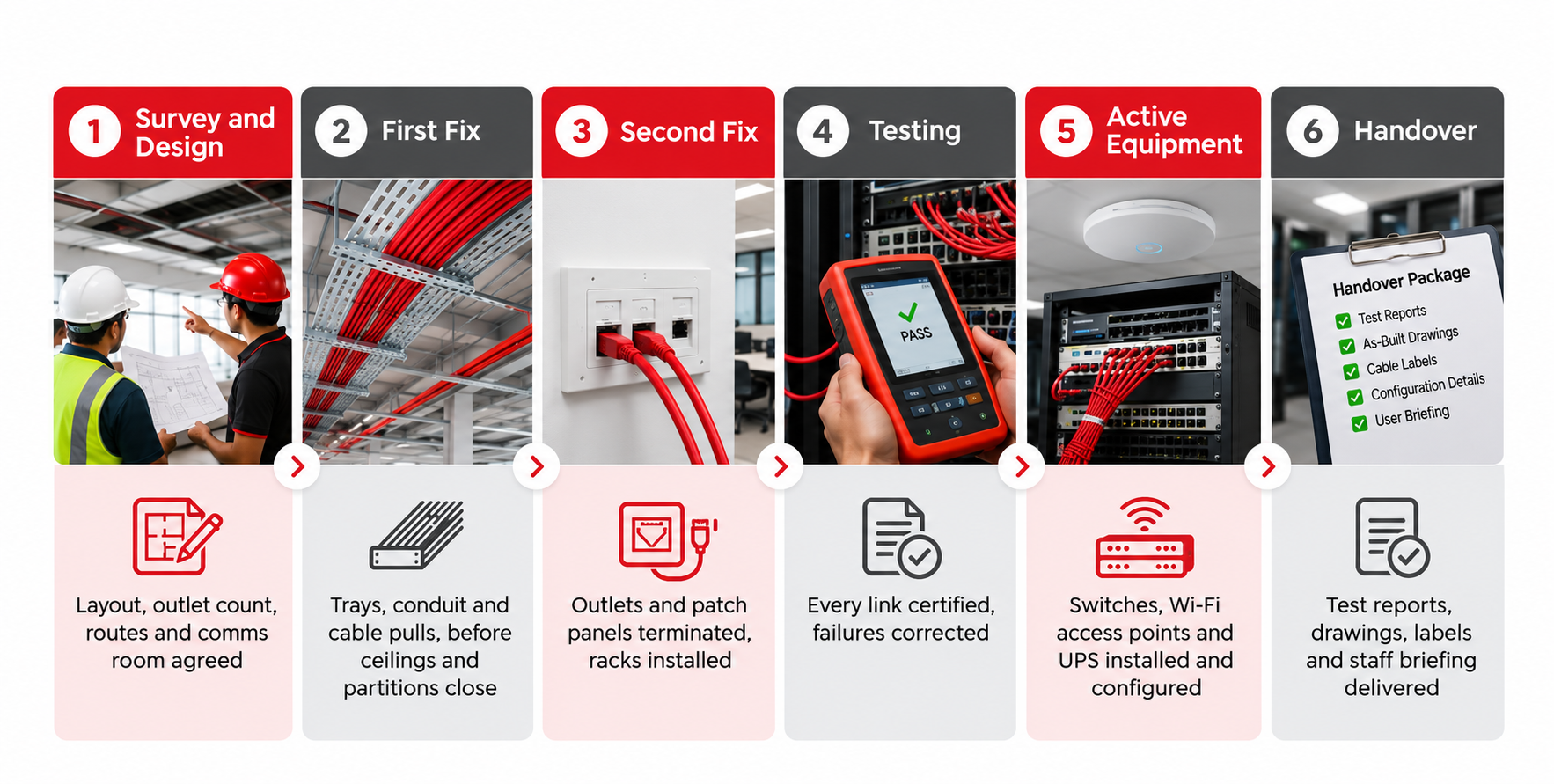
A small office typically takes a few days to two weeks. Multi-floor offices take several weeks, mostly driven by cable routes and the fit-out schedule. This is the usual sequence:
There is no fixed price. These factors move the quotation:
Ask for an itemised, dated quotation, because imported cable and equipment prices move with the exchange rate.
Two is a common planning figure, with extra outlets for printers, access points, cameras and door controllers.
100 m for the whole channel, made up of up to 90 m of permanent cable plus patch cords.
Sometimes. Have it tested and certified first, because older cable may limit speed or fail under load.
It needs at least a lockable, ventilated cabinet with power backup, so equipment is protected and cabling stays tidy.
A cabling company designs, installs and certifies the passive infrastructure. IT support manages devices, users and software. A network installation service often covers cabling and the installation of active equipment.
It avoids gaps between trades. One team can size PoE power, bandwidth and backup for cameras, access control and Wi-Fi from the start.
Planning a fit-out or office move? Speak to our network installation services Lagos team about cabling, racks and Wi-Fi, and ask how we integrate your commercial security systems Lagos on the same network.